

Could a Donald Trump-shaped torpedo sink Australia’s $368bn Aukus submarine plans?
Story by Daniel Hurst • 13h ago - 15-3-2023
In an attempt to put that enduring commitment beyond doubt, Australia has agreed to sling a few billion dollars towards the US over the next four years to prop up its already strained production capacity. This could well be politically unpalatable at a time of budget pressures, but Canberra considers this a necessary downpayment towards the US being prepared to sell at least three (and as many as five) of its Virginia class submarines to Australia in the 2030s. Still, it is not hard to imagine a future president – Trump or otherwise – rethinking that sale on the basis of prioritising US needs above those of Australia.
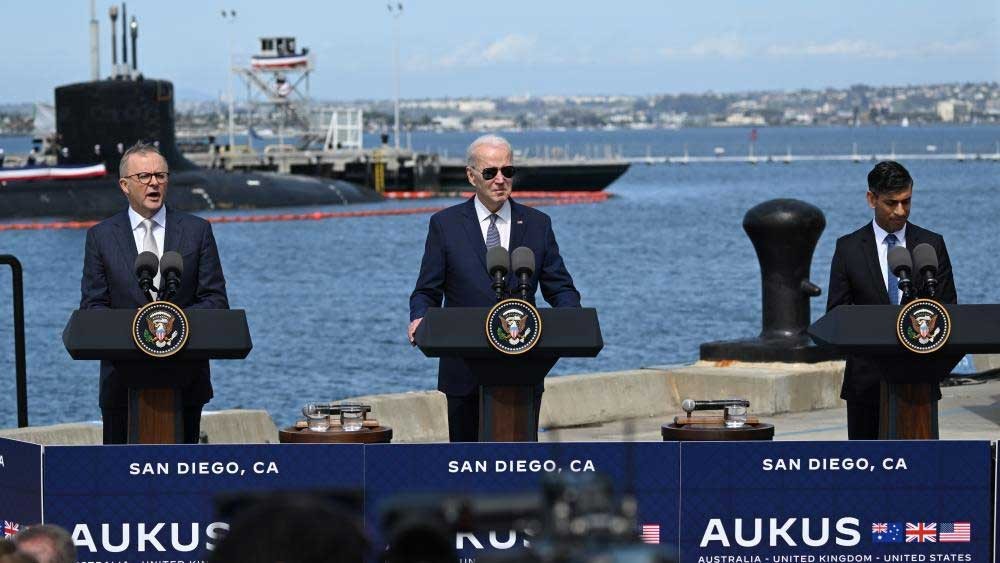
“The Aukus agreement we confirm here in San Diego represents the biggest single investment in Australia’s defence capability in our history,” the Australian prime minister, Anthony Albanese, said in San Diego alongside Biden, and the UK’s Rishi Sunak, all three surrounded by their flags.
In the meantime, work will begin to prepare the Osborne shipyard in South Australia for the massive undertaking of building a British-designed submarine featuring US tech, as the longer term solution. Construction is meant to start by the end of this decade, but the first of these Australian-built boats is not likely to be ready for the Royal Australian Navy until the 2040s onwards.
The Australian government was out and about on Tuesday promoting the opportunities created by Aukus: potentially thousands of jobs in the long term, a boost to science and tech knowhow, and the revival of domestic manufacturing. These could well be significant. But the security partnership is also full of risks.
The first relates to the cost. The forecast range of $268bn to $368bn between now and the mid 2050s is a cumulative bill for the entire program – including building up the facilities in Australia, buying the Virginia class subs, building the next-generation British designed submarine, and sustaining them all.
Most of this spending is beyond the first four-year budget period, and the government plays down the cost by saying it equates to 0.15% of gross domestic product a year on average. This submarine program cost is a subset of a Labor pledge to spend, overall, at least 2% of GDP on defence each year. But history tells us the cost of defence acquisitions only ever go up.
Another risk surrounds the technical complexity of the project, and whether Australia will face difficulties recruiting and training up the naval personnel, other supporting workers and nuclear specialists who will be required to make it a success (and operate the boats safely).
Going for a new design is also inherently risky – although the defence industry minister, Pat Conroy, said on Tuesday the government had sought to reduce that risk by having a delay of a few years between the first submarine entering into the UK’s service and the first one being handed over to the Australian navy.
4 yr. ago