

Washington Examniner
How and why the US must prevent Russia from downing more drones
by Tom Rogan, National Security Writer & Online Editor | March 16, 2023 03:34 PM
Although it seems to have been accidental, Russia downed a U.S. Air Force MQ-9 Reaper drone operating in international airspace on Tuesday. The question: How to prevent a similar incident from occurring in the future?
The question needs answering. For a start, each MQ-9 costs approximately $18-$32 million.
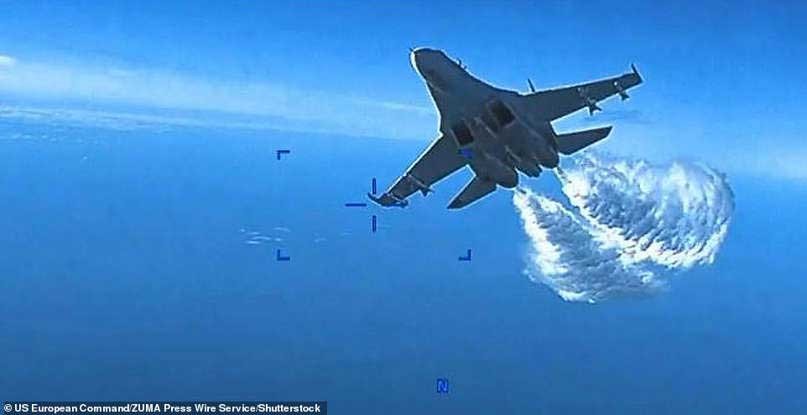
Tuesday's loss occurred when two Su-27 Russian naval aviation or air force fighter jets intercepted the drone over the Black Sea. Dumping fuel into its flight path, the Russians evidently sought to disrupt the drone's intelligence-gathering activities and harass its remote operators. One Russian pilot apparently then miscalculated and flew into the drone, forcing its operators to send it crashing into the Sea.
We can be confident, albeit not certain, that the downing was accidental.
After all, the risk to the Russians was significant. Had the Russians wanted to bring the drone down with surety, they could have simply fired upon it. Russian media reports, which should be judged with caution, claiming that the drone has been located at a depth of 800 meters. The U.S. insists it wiped the drone's data core, but if they have located the drone, the Russians might be able to recover valuable intelligence related to its processing, imaging, and sensor systems.
Thus far, the Biden administration has dealt with this mini-crisis via diplomatic protests and warnings that it must not be repeated. The Russians, however, will likely view that response as timid.
While Vladimir Putin has no interest in a direct military conflict with the U.S. or NATO, he is a strategic opportunist who is willing to take risks. Amid rising statements of skepticism about the Biden administration's Ukraine policy from the leading presumptive candidates to replace Biden, Donald Trump, and Ron DeSantis, Putin may regard Biden's response here as an indication he is increasingly cautious over the war.
That U.S. P-8 Poseidon maritime surveillance aircraft appear to have kept within Romanian airspace during recent Black Sea operations may also fuel Putin's sense that he can escalate. After all, the P-8s could presumably better accomplish their mission if they were actually flying over the Black Sea.
How and why the US must prevent Russia from downing more drones
by Tom Rogan, National Security Writer & Online Editor | March 16, 2023 03:34 PM
Although it seems to have been accidental, Russia downed a U.S. Air Force MQ-9 Reaper drone operating in international airspace on Tuesday. The question: How to prevent a similar incident from occurring in the future?
The question needs answering. For a start, each MQ-9 costs approximately $18-$32 million.
Tuesday's loss occurred when two Su-27 Russian naval aviation or air force fighter jets intercepted the drone over the Black Sea. Dumping fuel into its flight path, the Russians evidently sought to disrupt the drone's intelligence-gathering activities and harass its remote operators. One Russian pilot apparently then miscalculated and flew into the drone, forcing its operators to send it crashing into the Sea.
We can be confident, albeit not certain, that the downing was accidental.
After all, the risk to the Russians was significant. Had the Russians wanted to bring the drone down with surety, they could have simply fired upon it. Russian media reports, which should be judged with caution, claiming that the drone has been located at a depth of 800 meters. The U.S. insists it wiped the drone's data core, but if they have located the drone, the Russians might be able to recover valuable intelligence related to its processing, imaging, and sensor systems.
Thus far, the Biden administration has dealt with this mini-crisis via diplomatic protests and warnings that it must not be repeated. The Russians, however, will likely view that response as timid.
While Vladimir Putin has no interest in a direct military conflict with the U.S. or NATO, he is a strategic opportunist who is willing to take risks. Amid rising statements of skepticism about the Biden administration's Ukraine policy from the leading presumptive candidates to replace Biden, Donald Trump, and Ron DeSantis, Putin may regard Biden's response here as an indication he is increasingly cautious over the war.
That U.S. P-8 Poseidon maritime surveillance aircraft appear to have kept within Romanian airspace during recent Black Sea operations may also fuel Putin's sense that he can escalate. After all, the P-8s could presumably better accomplish their mission if they were actually flying over the Black Sea.
4 yr. ago